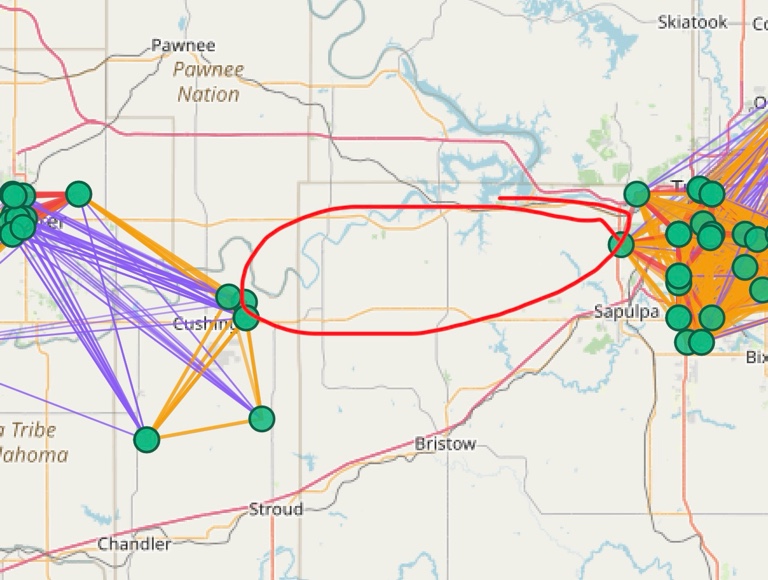
We’ve installed a new directional link in Cushing aimed at bridging the ~44 mile gap to Tulsa’s mesh network.
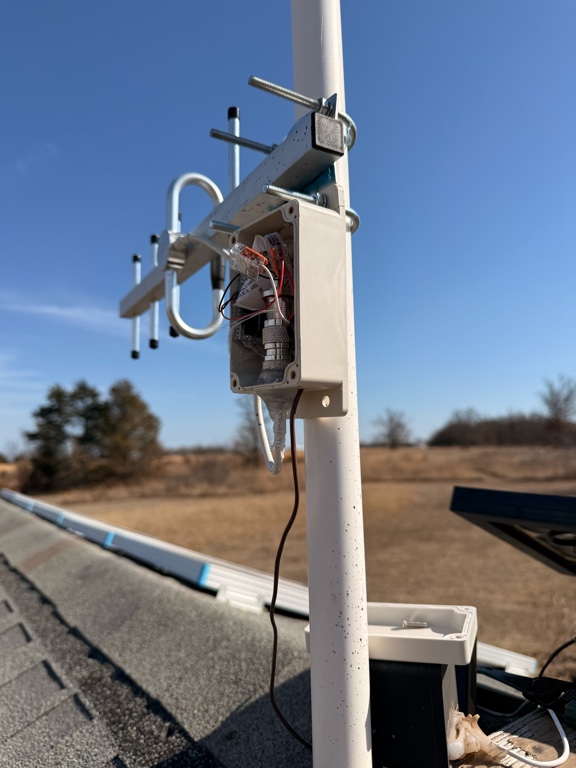
Setup Details
- Hardware: Heltec V3 in weatherproof enclosure
- Antenna: 900MHz Yagi (directional)
- Bearing: 86° (due East toward Tulsa)
- Tilt: ~1° above horizon
- Power: Solar panel for autonomous operation
- Mode: LongFast (mesh-compatible)
Link Engineering
The Challenge
Cushing and Tulsa don’t have direct line-of-sight. At 44 miles apart, we needed to understand what’s between us.
Terrain Analysis
We pulled elevation data along the path and found a critical feature:
Elevation Profile: Cushing → Tulsa (44 miles)

ft
1000 ┤                    ⛰️ RIDGE (997ft)
 950 ┤              ▄▄▄▄▄▀▀▀▀▄
 900 ┤▄▄▄         ▄▀          ▀▄       ▄
 850 ┤  ▀▄▄▄▄▄▄▀▀              ▀▄▄▄▄▄▀ ▀▄    TULSA
 800 ┤                                   ▀▄▄▀▀(869ft)
 750 ┤                              ▄▄▄▀▀
 700 ┤                          ▄▄▀▀
     └────────────────────────────────────────
     0    10    20    30    40 miles
   CUSHING                         TULSA
   (889ft)
| Location | Elevation | Distance |
|---|---|---|
| Cushing (Start) | 889 ft (271m) | 0 mi |
| Ridge (Highest Point) | 997 ft (304m) | 22 mi |
| Tulsa (Target) | 869 ft (265m) | 44 mi |
The Strategy: Knife-Edge Diffraction
The ridge at mile 22 is about 108 feet higher than our location. Rather than being an obstacle, we’re using it as an advantage:
- Knife-edge diffraction — Radio waves bend over sharp terrain features. By aiming our yagi just above the ridge (+1° tilt), the signal diffracts over the top and continues toward Tulsa.
- Why +1° tilt? — The angle to the ridge obstruction is ~0.05°. Adding 0.5-2° clearance gives us the best chance of catching the diffraction zone.
900MHz Propagation Notes
At 900MHz (LoRa), we can also benefit from:
- Tropospheric scatter — Signal scattering off atmospheric turbulence (best at low angles)
- Temperature inversions — Ducting conditions, especially early morning or after weather fronts
Why Directional?
We already have a router with an omni antenna covering Stillwater and local mesh traffic. This dedicated yagi concentrates all our TX power toward Tulsa, effectively multiplying our reach in that direction (typical yagi gain: 10-12 dBi).
Target: TUL_SSSTower — a well-positioned router node in the Tulsa area. Fingers crossed! 📡